
Pool deck ideas: building everything around your pool
On this page · 7 sections
Most people who call us about a pool deck already have a pool. The water is fine. It's everything around it that's cracked, slick, faded, or never got finished in the first place. That's the part we build: the deck, the steps, the walls, the walkway out to the gate, and the patio where everyone ends up after they dry off. We don't build the inside of the pool, but we work with pool contractors who do, so if you're starting from a hole in the ground, the deck can still be planned alongside the pool.
And it doesn't have to be concrete. We pour plenty of broom-finished and stamped concrete around pools, but we also lay pavers and natural stone. In fact, we just finished a giant travertine pool. Here's how we think through the space around a pool, from the surface underfoot to the details a bid should spell out before you sign it.
The short answer
Bottom Line Up Front
Your pool deck doesn't have to be concrete. Stamped concrete, broom-finished concrete, pavers, and travertine all work around a pool. What has to be right every time is the thickness, the concrete quality, the drainage, the bonding wire under the deck, and the seal on anything stamped.
We build everything around the pool, not the pool itself, and we work with pool contractors when the water isn't in yet. Pick the surface for how it looks and how you'll use the space, then hold whoever builds it to the details that make it last.
on our work
wash, and seal
of our projects
The rest of this post walks through what a pool deck has to do, how the materials compare, what else belongs around the water, and the questions that separate a deck that lasts from one that cracks in a season.
Start with what the deck has to do
A pool deck takes more abuse than almost any other slab on the property. It's wet, it's walked on barefoot, it carries chairs, tables, and coolers, and it has to meet the pool's coping cleanly so nobody catches a toe at the edge. Water has to drain away from the pool and away from the house, not sit in low spots. Before we talk about colors or patterns, we look at how the space gets used and where the water goes.
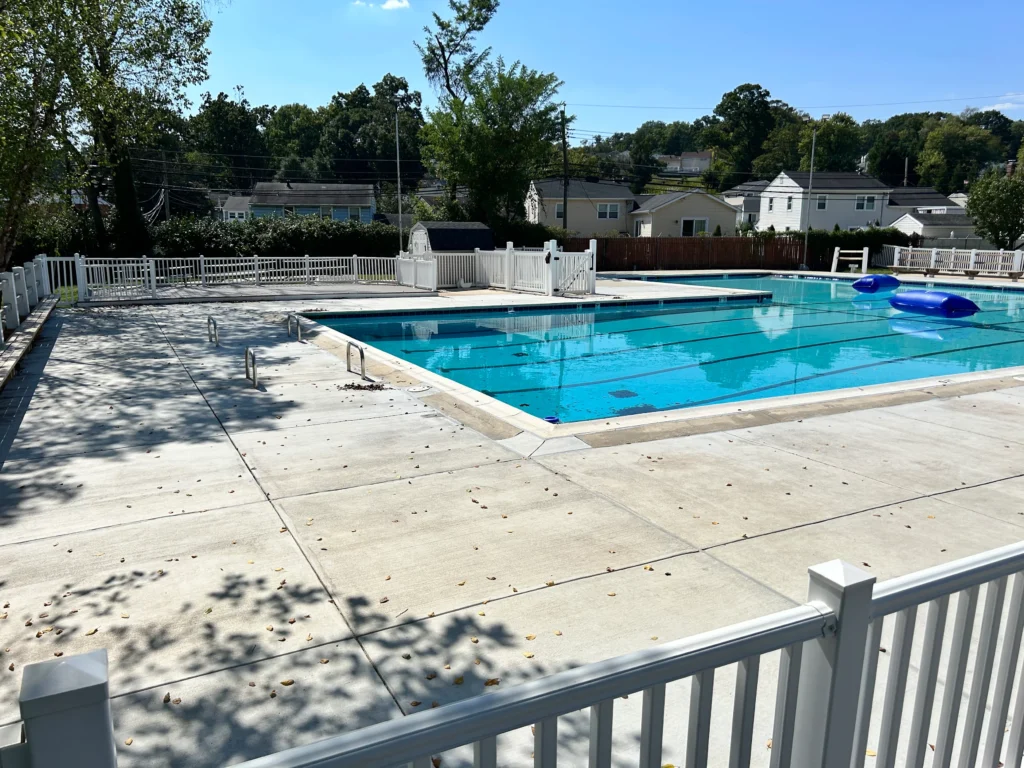
At Wynnewood Recreation Center, we replaced the deck around a large community pool. A deck that size is full of things that have to be worked around and set right: a Loop-Loc safety cover system, diving board mounts, flag poles, 5 ladders, and 6 starting blocks. We poured new concrete with a light broom finish for slip resistance and evenly spaced saw-cut control joints to help manage cracking, and ran the slabs right up to the pool coping and the shallow-entry steps.
Then we made sure the water had somewhere to go. The entire deck is graded to slope away from the pool, and we installed French drains along the perimeter of the pool to help carry off rainwater. Once all the work was done, we water tested the deck to make sure there was no puddling or standing water.
Not everything under an old deck is in good shape. At Wynnewood, the wiring for the pool's 11 lights had been laid in the old concrete, poorly. Before any pouring could begin, the center had an electrician come in and run new lights and conduit. If something like that turns up when your old deck comes out, it has to be fixed before anything new goes down.
Concrete, pavers, or travertine?
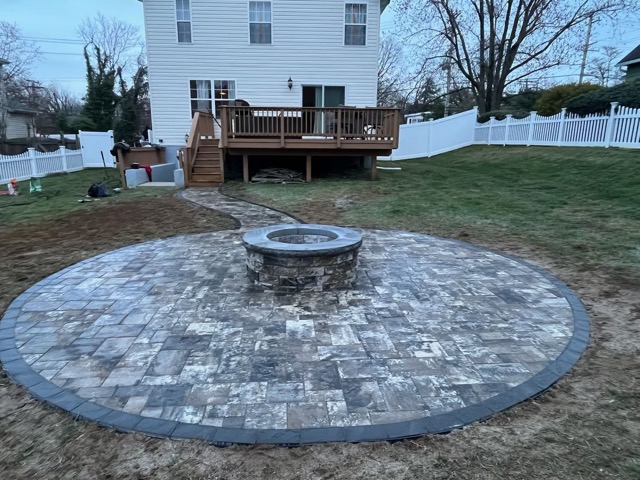
There's no single right surface for a pool deck, and anyone who tells you otherwise probably only installs one of them. Plain poured concrete with a broom finish is the workhorse. Stamped concrete gives you a pattern and color pressed into one continuous slab. Pavers from Nicolock and Belgard come in a wide variety of colors and shapes, and natural stone like travertine gives you a look nothing else quite matches.
| Factor | Poured & Stamped Concrete | Pavers & Travertine |
|---|---|---|
| The look | Broom finish, or stamped and colored | Nicolock or Belgard pavers, or natural travertine |
| Surface | One continuous slab | Individual pieces set side by side |
| Footing when wet | Broom finish adds slip resistance | Depends on the stone and finish you choose |
| Managing cracks | Saw-cut control joints placed by plan | Joints between every piece |
| Fixing one area later | A repair shows as a patch | Pieces can be lifted and reset |
| What to check in the bid | Concrete quality, thickness, and the seal | Brand, pattern, and color |
| Pool bonding | Has to be there | Has to be there |
This reflects how we build pool decks around Glen Burnie. The right surface depends on your pool, your yard, and how you use the space, so most decisions come down to more than one row.
Around a pool, the wiring or mesh under the deck matters more than the finish on top. It's there to keep electricity from getting out of your pool, and it has to be there to keep you safe. Copper equibond wire roll is important. Whoever builds your deck, ask what bonding goes in and make sure it's in the scope before anything is poured or laid.
Everything else that belongs around the pool
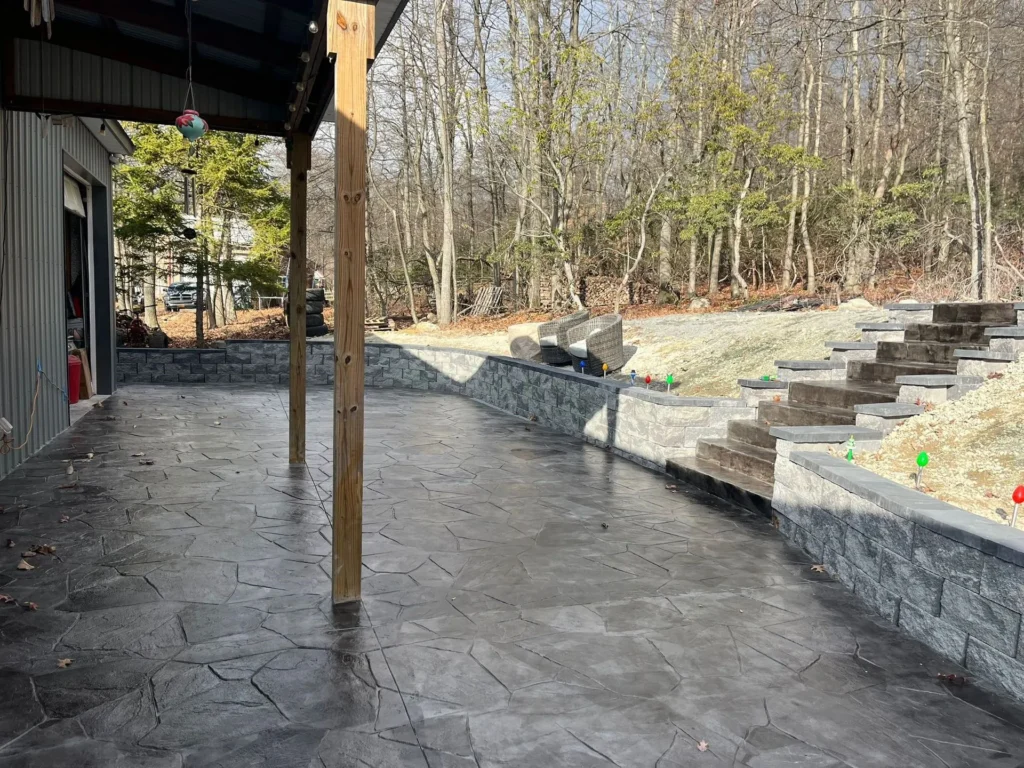
A deck is rarely the whole project. Most pool areas also need a way to get there, a place to sit, and something that holds back the yard. That can mean steps down a slope, a walkway from the back door, a seating wall, a fire pit, a fence around the whole thing, or planting to soften the edges. We handle the hardscaping, the fencing, the landscaping, and even a raised deck off the house, so the pool area comes together as one plan instead of four separate contractors.
Retaining walls and drainage come up more often than people expect. Right now we're pouring a retaining wall in the water on a job a landscaper referred to us, and the client was so happy that they kept adding more and more to the project. That's usually how it goes: once the space around the water works, people start seeing what else it could be.
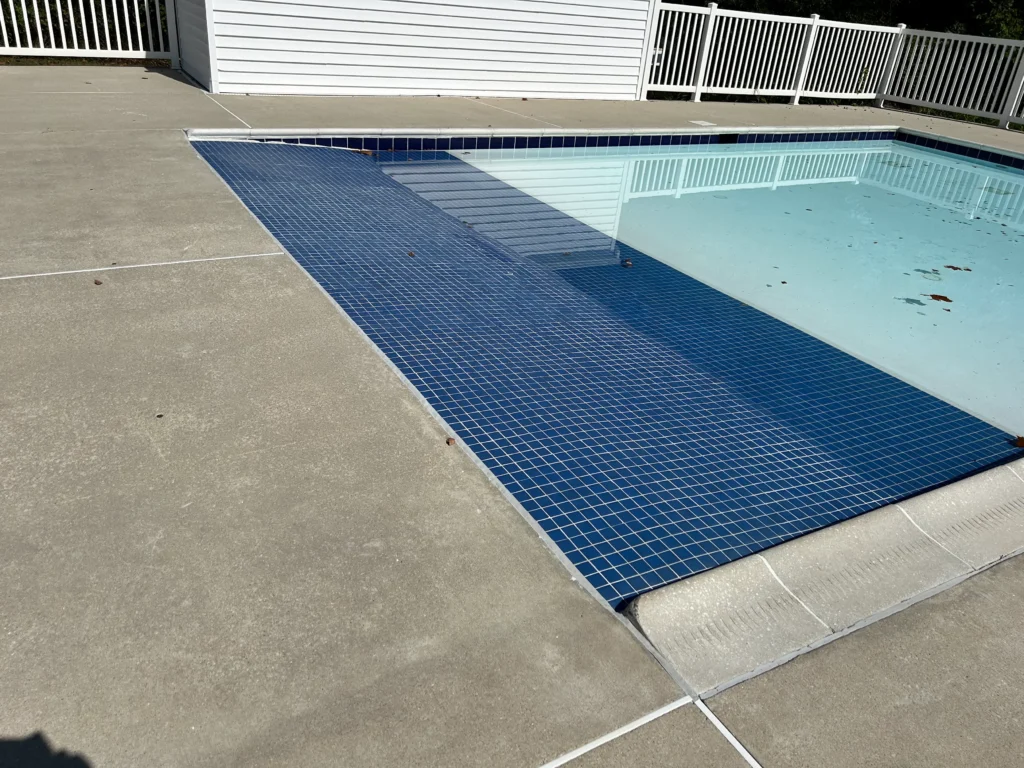
Sometimes the best addition is a replacement. After the Wynnewood deck was finished, the center brought us back to replace a deteriorating splash pad. Because splash pads deteriorate quickly, we recommended skipping a new one and installing non-slip tile in its place.
“People expect a pool deck to take weeks. We'd rather your backyard stop being a construction site in a couple of days — and look like nobody was ever there except for the new deck.”— Brijo Concrete Solutions, LLC
What a good pool deck bid spells out
Two bids for the same pool deck can look wildly different on price, and the reason is usually in what one of them leaves out. Before you compare totals, compare what each contractor is actually promising to put in the ground. We've covered this in more detail in our guide to reading a concrete estimate, but around a pool these are the lines that matter most. On the Wynnewood job, we stuck to the price we bid and to the center's budget.
What a good bid spells out
The details that decide whether the deck lasts.
What to look for
- The thickness of the pour, stated in inches rather than left out.
- What quality of concrete is going in and where it comes from.
- The bonding wire or mesh under the deck, named in the scope of work.
- For stamped concrete, a final seal coat listed as its own step.
Where corners get cut
Each one saves the contractor money now and costs you later.
What to watch for
- A price around half of the other bids, with no thickness listed anywhere.
- Cheap concrete that's prone to cracking.
- No mention of bonding wire or mesh anywhere near the pool.
- A stamped deck with no seal step, the liquid that goes on once everything else is done.
We've given estimates where homeowners tell us another contractor came in at half the price. When we look at that bid, the answer is usually right there: not enough inches of concrete for a pour that will last. Thickness matters, and so does the quality of the concrete. We source ours from plants with lower gravel content to help improve the quality of our pours. A cheaper slab that cracks in a couple of seasons is the most expensive deck you can buy.
Going with stamped concrete? Ask about the seal
Stamped concrete is a big part of what we do, and it's a popular choice around pools because it gives you pattern and color in one continuous surface. The process has an order to it: stamp it, add the color, let it dry, wash it, then seal it. The seal is a liquid applied at the very end, once everything else is done, and it's the step some contractors skip to save time.
Make sure the seal is in the bid, and ask when it goes on. If you already have a stamped deck, our guide to sealing and maintaining stamped concrete covers what keeps it looking right year after year.
The bottom line
Your pool deck can be broom-finished concrete, stamped concrete, pavers, or travertine. The material is a choice about looks and feel. What isn't optional is the work you can't see: the right thickness, good concrete, proper drainage, the bonding under the deck, and the seal on anything stamped. Get those right and the surface you pick will hold up to wet feet and Maryland weather.
If you're ready to plan the space around your pool, take a look at our pool deck work and the project gallery, then tell us about your project through our contact form or call 240-302-1823. We'll talk through what you need, come out for a free estimate, and leave your yard as clean as we found it.